If your Yuma home has a textured “popcorn” ceiling and it has been there since before you owned the place, you have probably wondered whether it contains asbestos. It is a fair question, and the honest answer is shorter than most articles make it.
The Short Answer: You Cannot Tell by Looking
There is no visual test for asbestos in a popcorn ceiling. Asbestos fibers are microscopic, and texture containing them looks exactly like texture that does not. No color, no texture pattern, and no sparkle tells you either way. Anyone who says they can tell from the ground, or from a photo, is guessing.
The only definitive answer comes from laboratory analysis of a physical sample taken from the ceiling. That is the entire method. Everything else, including everything below about construction dates, only shifts the probability.
For a free look at your ceiling and straight answers about testing, call Aquasafe Restoration at (928) 750-1670. We are a Certified AHERA Asbestos Contractor and licensed in Arizona.
Why Age Narrows It Down but Never Settles It
The dates matter, but they are messier than people expect. In 1977 the U.S. Consumer Product Safety Commission banned asbestos in textured ceiling products, and Clean Air Act amendments the following year restricted spray-applied asbestos surfacing materials in buildings.
That sounds like a clean cutoff. It was not. Manufacturers were not required to recall inventory already sitting in warehouses, and contractors kept spraying that existing stock onto new ceilings well into the mid-1980s. So a ceiling installed in 1983 can absolutely contain asbestos even though the material was banned six years earlier.
Practical read for Yuma homeowners:
- Before 1980: treat it as asbestos-containing until a test says otherwise.
- 1980 to roughly 1986: genuinely uncertain, and worth testing before any work.
- After the late 1980s: unlikely, though a later re-texture over an original ceiling muddies this.
Older neighborhoods in Yuma and the border communities of San Luis, Somerton and Gadsden carry a lot of housing from that window. Our guide to asbestos in older Yuma homes covers the other materials worth knowing about.
What Popcorn Ceiling Asbestos Testing Actually Involves
Testing is straightforward and far less disruptive than homeowners expect. A small sample of the texture is collected from an inconspicuous spot, sealed, and sent to an accredited laboratory. Aquasafe Restoration collects the sample; the analysis is done by the lab.
The lab examines it under polarized light microscopy, the EPA standard method for bulk building materials. Under federal rules and the AHERA standard, a material counts as asbestos-containing when it is more than 1 percent asbestos by weight. Because the reading gets less reliable near that threshold, EPA requires an additional point-counting procedure on samples that come back under 10 percent.
You get back a written result that either clears the ceiling or does not. That single piece of paper determines everything downstream: whether you can scrape it yourself on a Saturday, or whether the job needs containment and licensed disposal.
Why Scraping First Is the Expensive Mistake
Intact popcorn texture is not doing anything to you. The fibers are bound into the material and are not circulating in your air. The risk begins the moment the material is disturbed, and textured ceiling is unusually easy to disturb because it is friable, meaning it crumbles under hand pressure.
Scraping a ceiling dry is close to the worst-case way to handle it. So is sanding it, running a drill through it to hang a fan, or pulling down a section that has sagged. Each of those puts fibers into the air of a closed room, and in a Yuma summer with the house sealed and the air conditioning recirculating, those fibers move through the whole home.
The cost consequence is real too. Testing a ceiling is a small expense. Cleaning up a house where someone already scraped an asbestos ceiling is a much larger one, because the contamination is no longer confined to the ceiling. Test first. It is the cheapest step in the entire sequence.
What the Rules Are in Yuma County
Yuma sits outside Arizona’s three delegated asbestos counties, which are Maricopa, Pima and Pinal. That means covered projects here follow the default federal NESHAP standard, and the notification goes directly to the Arizona Department of Environmental Quality rather than to any local county office. When a project is covered, that notice is due at least 10 working days before work starts.
Most homeowners reading this are exempt from that paperwork. Under the federal standard Yuma follows, an isolated single-family home with four or fewer dwelling units is generally exempt from the notification requirement, for renovation and for demolition alike. The exemption falls away if your house is part of a larger commercial or public project.
Being exempt from notification is not the same as being exempt from everything. Safe handling still applies, Arizona licensing rules still apply to whoever you hire, and the waste still has to go to a facility licensed to take it. The full breakdown is in our guide to Yuma asbestos rules and permits.
What Professional Removal Looks Like
When a test comes back positive and the ceiling has to come out, the work follows a set sequence:
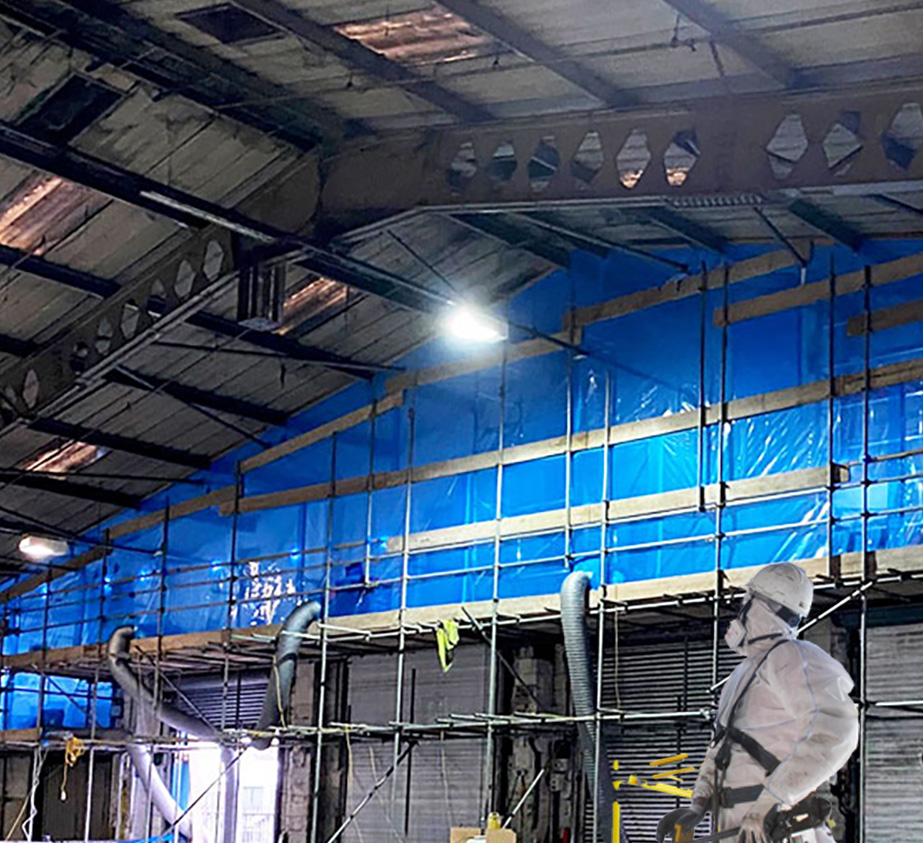
- Containment. The room is sealed with plastic sheeting and put under negative air pressure with HEPA filtration, so nothing migrates into the rest of the house.
- Wet removal. The texture is thoroughly wetted before it is touched. Wet material does not release fibers the way dry scraping does.
- Controlled disposal. Waste is double-bagged, labeled, and taken to a facility licensed to accept asbestos.
- HEPA cleanup and clearance. The contained area is HEPA vacuumed and wiped before containment comes down.
- Rebuild. The ceiling is refinished so you are not left with bare drywall.
Cost varies with square footage, ceiling height, how much containment the layout demands, and disposal volume, which is why asbestos removal cost in Yuma is a range rather than a number. Estimates are free.
When You Can Leave It Alone
Removal is not automatically the right answer, and we would rather say that than sell an unnecessary job. If your popcorn ceiling tests positive but is intact, sealed under paint, out of reach, and you have no plans to renovate, leaving it undisturbed is a legitimate choice. Undamaged asbestos material that nobody touches is not putting fibers into your air.
Removal becomes the right call when the ceiling is already damaged or flaking, when water has stained or loosened it, when you are renovating and cannot avoid disturbing it, or when you are selling and want it resolved for a buyer.
The one situation that forces the issue is water. A monsoon roof leak that soaks a textured ceiling can detach the material on its own, which is the exact scenario asbestos rules exist for. If you have both problems at once, they need to be handled together, not as a water damage job followed by an asbestos surprise.
Getting Your Popcorn Ceiling Tested in Yuma
Aquasafe Restoration has handled asbestos removal across Yuma County for more than 20 years. We are a Certified AHERA Asbestos Contractor and Supervisor, licensed in Arizona and insured. We collect the sample, an accredited lab analyzes it, and you get a written answer before anyone touches the ceiling.
If the result is negative, you have lost nothing but a few days. If it is positive, you will know exactly what you are dealing with before you make any decisions about it.
Call (928) 750-1670 for a free estimate anywhere in Yuma, Fortuna Foothills, Somerton, San Luis, Wellton or Gadsden.